


When the lights go out, an emergency generator can feel like a hero in the driveway. It can keep a refrigerator cold, a sump pump running, a phone charged, or a medical device powered long enough to get through a power outage. But here is the non-negotiable truth: a portable generator is not just an appliance. It is a fuel-burning engine and a temporary electrical source, which means the big hazards are carbon monoxide poisoning, fire, electric shock, electrocution, and overload. The safest generator plan starts before the storm, not after the house is dark. Select the best home emergency generator.
This guide walks U.S. homeowners and renters through the practical, safety-first steps for operating a portable generator during an outage. Use it as a plain-English checklist, then match every step to your generator’s manual, your transfer equipment, and your local code requirements.
Safety first: If you remember only one rule, remember this one: never run a generator indoors, in a garage, on a porch, on a balcony, in a shed, or near openings to the home. Carbon monoxide from a portable generator can be deadly, and CPSC warns that one portable generator can produce as much carbon monoxide as hundreds of cars. (cpsc.gov)
Table of Contents
Know the Three Big Generator Hazards
A portable generator solves one problem and creates several others if it is used casually. Before starting the engine, think through these hazard categories:
- Carbon monoxide, or CO
CO is colorless and odorless. You cannot “sniff test” your way to safety. Symptoms can include headache, dizziness, weakness, nausea, vomiting, sleepiness, and confusion. If anyone feels sick, weak, or dizzy while a generator is running, move to fresh air immediately and call 911. CPSC recommends battery-operated or battery-backup CO alarms on every level of the home and outside sleeping areas. (cpsc.gov) - Electric shock and backfeed
A generator can energize cords, appliances, and wiring. If connected improperly to a home’s electrical system, it can also send power backward into utility lines. That can endanger utility workers, neighbors, and your household. Red Cross specifically warns never to power house wiring by plugging a generator into a wall outlet, a dangerous practice known as backfeeding. (redcross.org) - Fire and burns
Fuel vapors, hot mufflers, overloaded cords, and spilled gasoline are common risk points. Refuel only after the generator is turned off and cooled, and store fuel in approved containers outside living areas. (redcross.org)
Step 1: Decide Whether You Can Use a Generator Safely at Your Home
Not every home is a good candidate for a portable generator. That is especially true for apartments, condos, townhomes, row houses, dense urban lots, and rentals where there may be no safe outdoor placement.
A safe operating location must be:
- Outdoors, never partially enclosed.
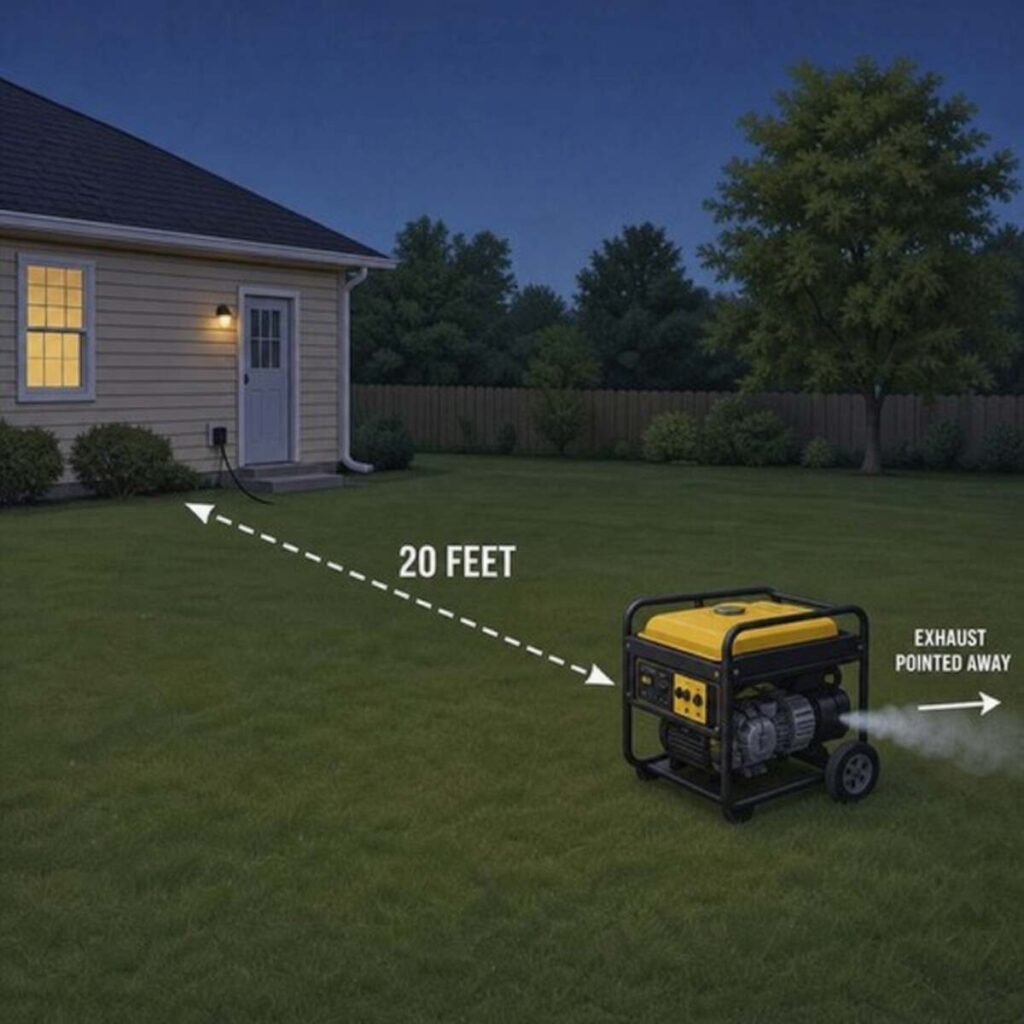
- At least 20 feet away from doors, windows, vents, crawlspace openings, and other places where exhaust can enter.
- Positioned so exhaust points away from your home and neighboring homes.
- Dry, level, and protected from standing water.
- Far from combustible materials, stored fuel, leaves, mulch, fences, and openings.
- Accessible without running cords through a doorway or window in a way that compromises CO safety or weather protection.
The CDC says to keep a generator outside at least 20 feet from any doors, windows, or vents. NFPA also advises measuring the 20-foot distance from the generator to the building and directing exhaust away from openings. (cdc.gov)
Renter and apartment caution
If you rent, do not assume you can operate an emergency generator just because you own one. Many leases, HOAs, condo associations, and local fire rules restrict fuel storage, balcony use, noise, and temporary electrical equipment. A balcony, breezeway, hallway, stairwell, garage, or covered porch is not a safe generator location. If you cannot place the generator outdoors at a safe distance with exhaust pointed away from all openings, choose another backup option, such as battery power stations, UPS units for electronics, or relocation during an extended power outage.
Step 2: Set Up Carbon Monoxide Protection Before the Outage
The generator belongs outside. CO alarms belong inside. You need both.
Install CO alarms:
- On every level of the home.
- Outside sleeping areas.
- Near bedrooms according to the alarm manufacturer’s placement instructions.
- With battery backup or battery operation so they work during an outage.
- Interconnected if possible, so when one sounds, all sound.
CPSC recommends CO alarms on every level and outside sleeping areas, and notes that interconnected alarms are best because one alarm triggers all of them. (cpsc.gov)
Placement checklist for CO prevention
Before starting your portable generator, confirm:
- The generator is outdoors only.
- It is at least 20 feet from doors, windows, vents, and attached structures.
- The exhaust is pointed away from the house.
- It is not in a garage, even with the door open.
- It is not under an attached porch, deck, carport, or overhang that can trap exhaust.
- It is not next to a neighbor’s window, door, crawlspace vent, or intake.
- Wind is not pushing exhaust toward openings.
- CO alarms are working inside the home.
Do: Walk around the house after setup and look for every possible air opening near the generator.
Don’t: Decide that “outside” is safe enough if the generator is near a window, under a roofline, or in an attached garage. Opening doors and windows does not make indoor or garage operation safe. Red Cross states that fans or open doors and windows will not prevent CO buildup in the home. (redcross.org)
Step 3: Choose the Right Fuel and Handle It Like a Fire Hazard
Portable generators may run on gasoline, propane, diesel, natural gas, or a dual-fuel or tri-fuel combination. The safest fuel is the fuel your generator was designed to use, in the way the manual tells you to use it.
Gasoline
Gasoline is common, easy to find, and highly flammable. It also gets stale over time, can spill during refueling, and gives off vapors that can ignite. Store gasoline only in approved, clearly labeled containers. Keep containers closed, cool, ventilated, and outside living areas. CPSC says portable fuel containers should be stored in well-ventilated, cool areas and should never be stored inside a house, basement, or near ignition sources such as pilot lights, stoves, heaters, or electric mowers. (cpsc.gov)
Propane
Propane can store longer than gasoline and is common for dual-fuel generators. Keep cylinders upright, outdoors, secured, and away from heat sources. Use the hose, regulator, and cylinder size specified by the manufacturer. If you smell gas or suspect a leak, shut the system down if it is safe to do so, move away, and follow emergency guidance from your propane supplier or local authorities.
Natural gas
Some standby systems and certain portable tri-fuel setups can use natural gas. Do not improvise a connection. Gas piping, quick-connect fittings, regulator capacity, and appliance loads must be evaluated and installed by qualified professionals. A generator that starves for fuel may run poorly, damage equipment, or fail when you need it most.
Diesel
Diesel is common in larger generators. It is still a fire and spill hazard. Use the recommended grade, protect fuel from contamination, and store it according to local rules and the generator manual.
Refueling checklist
Before adding fuel:
- Turn off connected loads or transfer them off generator power.
- Turn the generator off.
- Let the engine and muffler cool according to the manual.
- Keep fuel containers away from the hot generator.
- Do not smoke or use open flames nearby.
- Fill slowly to avoid spills and do not overfill.
- Replace the fuel cap securely.
- Wipe up spills and move the fuel container away before restarting.
- Restart only when fumes have cleared and the generator is safe to operate.
Red Cross advises turning the generator off and letting it cool before refueling because gasoline spilled on hot engine parts can ignite. (redcross.org)
Do: Keep a properly rated fire extinguisher accessible and know how to use it.
Don’t: Store gasoline in the living space, basement, utility room, or next to a water heater, furnace, stove, dryer, or other ignition source. CPSC warns that fuel vapor can ignite if it encounters a spark or flame. (cpsc.gov)
Step 4: Use Extension Cords Safely, or Install a Proper Inlet and Transfer Device
There are two common ways to get power from an emergency generator to what you need:
- Plug appliances directly into the generator using appropriate extension cords.
- Connect the generator to selected home circuits through a professionally installed inlet and transfer switch or interlock.
Both can be safe when done correctly. Both can be dangerous when improvised.
Option A: Extension cords for direct plug-in loads
This is the simplest setup. You plug an appliance or device into the generator receptacle, either directly or through a heavy-duty outdoor-rated extension cord.
Use cords that are:
- Outdoor-rated.
- Three-prong and grounded, unless the appliance is specifically designed otherwise.
- Rated in watts or amps for the total connected load.
- In good condition with no cuts, cracks, repairs, exposed conductors, loose plugs, or missing grounding pins.
- As short as practical to reduce voltage drop.
- Routed where they will not sit in water, create a trip hazard, get pinched in doors, or run under rugs.
Red Cross says appliances should be plugged directly into the generator or into a heavy-duty outdoor-rated extension cord rated at least equal to the sum of the connected loads, and that cords should be checked for cuts, tears, and all three prongs. CPSC also identifies missing safety characteristics on extension cords, such as minimum wire size and proper continuity, as shock or fire risks. (redcross.org)
Do: Label your generator cords and store them with the generator so you are not hunting in the dark.
Don’t: Daisy-chain cords, use damaged cords, use indoor holiday cords outdoors, run cords through standing water, or overload a cord because “it worked last time.”
Option B: Inlet box with transfer switch or interlock
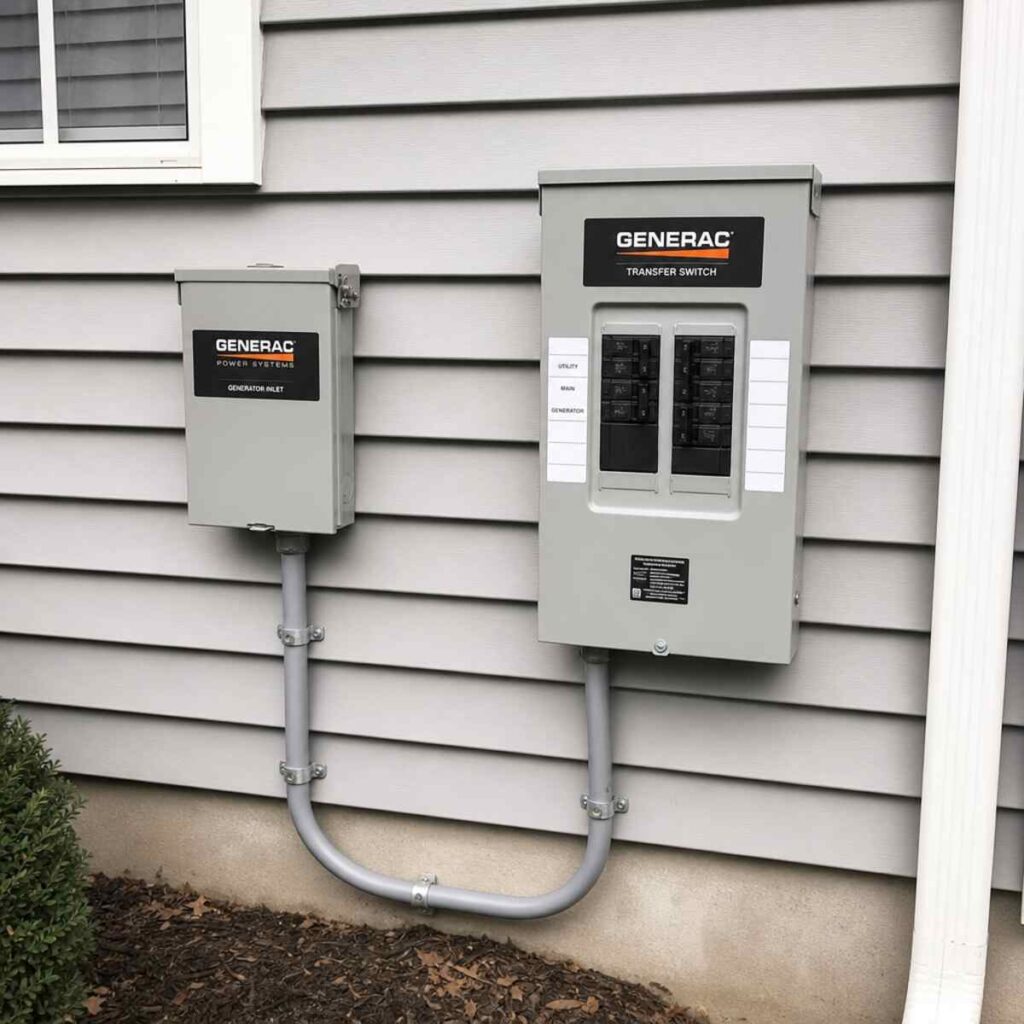
If you want to power hardwired loads, such as a furnace blower, well pump, sump pump circuit, refrigerator circuit, lighting circuit, or selected outlets, use a professionally installed generator inlet with a transfer switch or listed interlock system. This lets the generator feed specific circuits without running extension cords across the house.
A proper setup usually includes:
- An outdoor generator inlet rated for the generator output.
- A matching generator cord.
- A manual transfer switch, transfer panel, or approved interlock kit.
- Proper overcurrent protection.
- Correct grounding and bonding configuration.
- Permits and inspection where required.
- Installation by a licensed or qualified electrician.
NFPA advises that if a generator must connect to house wiring, a qualified electrician should install a properly rated transfer switch in accordance with the NEC and applicable state and local electrical codes. OSHA similarly says not to attach a portable generator directly to a structure’s electrical system unless it has a properly installed transfer switch. (nfpa.org)
Backfeed prevention is not optional
Never plug a generator into a wall outlet, dryer outlet, range outlet, or any homemade cord with two male ends. This is often called a “suicide cord” for good reason. It can energize utility lines, shock people, start fires, and damage the generator or appliances.
A transfer switch or approved interlock is designed to prevent the utility and generator from feeding the panel at the same time. Red Cross warns that backfeeding puts utility workers, neighbors, and your household at risk of electrocution. (redcross.org)
Do: Hire an electrician before storm season if you want whole-circuit backup.
Don’t: Wait until an outage, then try to invent a connection with adapters, dryer plugs, or online “hacks.”
Step 5: Understand Transfer Switches, Interlocks, and What They Do
A transfer switch or interlock is not just a convenience. It is the safety device that separates generator power from utility power.
Manual transfer switch
A manual transfer switch usually controls specific circuits or a transfer panel. You select which circuits are powered by utility and which are powered by the generator. It is a controlled, intentional way to power essentials.
Best for:
- Smaller portable generator setups.
- Selected critical circuits.
- Homeowners who want a clear, labeled process.
- Avoiding long extension cords.
Interlock kit
An interlock is a mechanical device installed on the electrical panel so the main breaker and generator breaker cannot be on at the same time. Interlocks must be designed for the specific panel and accepted by the authority having jurisdiction. They are not a universal DIY plate.
Best for:
- Panels that support a listed interlock.
- Users who understand load management.
- Setups where a qualified electrician confirms compatibility.
Automatic transfer switch
Automatic transfer switches are more common with permanently installed standby generators. Some portable setups use specialized equipment, but for most homeowners, a portable generator requires a manual process.
No matter the type, the goal is the same: prevent backfeed, protect people, and keep the generator from being overloaded.
Step 6: Calculate Your Load Before You Start Plugging Things In
A portable generator cannot power everything in a typical U.S. home. The art is not “How much can I run?” The art is “What matters most, and how do I run it safely?”
Start with essential loads
Make a list of what truly needs power during a power outage. Common priorities include:
- Refrigerator or freezer.
- Sump pump.
- Well pump, if applicable and if the generator and transfer equipment support it.
- Furnace blower or boiler controls for gas or oil heat, if properly connected.
- Medical equipment, with a backup plan approved by the equipment provider.
- Phone charging and communication devices.
- A few lights.
- Internet equipment, if service is still available.
- Small cooking appliances, used one at a time and within generator capacity.
Lower priority loads often include:
- Electric range.
- Electric dryer.
- Electric water heater.
- Central air conditioning.
- Space heaters.
- Large microwaves used alongside other loads.
- Hot tubs, pool pumps, and workshop tools.
High-heat electric appliances draw a lot of power. If you need heat, food, or hot water during an outage, plan for safe alternatives rather than assuming the generator can carry large electric loads.
Running watts vs. starting watts
Many motors need extra power for a moment when they start. Refrigerators, freezers, sump pumps, well pumps, furnace blowers, and some tools can draw significantly more power at startup than while running. Red Cross notes that some machines draw up to three times as much power when starting. (redcross.org)
Use this load-planning process:
- Find the generator’s running watts and starting watts rating.
- Find the wattage or amperage of each appliance you plan to run.
- If a label gives amps, estimate watts by multiplying volts by amps.
- Add the running watts of everything that may run at the same time.
- Add the largest likely starting surge.
- Keep a safety margin rather than operating at the edge of the generator’s rating.
- Start large motor loads one at a time.
- Turn off nonessential loads before starting another motor load.
Load prioritization checklist
During an outage, run your emergency generator like an energy budget:
- Start with life safety and medical needs.
- Add refrigeration to protect food.
- Add pumps needed to prevent flooding or maintain water.
- Add heat system controls if safe and properly connected.
- Add lights and communication.
- Add convenience loads only if capacity remains.
- Stagger loads instead of running everything at once.
- Watch for dimming, bogging, breaker trips, overheating cords, or unusual smells.
Red Cross warns that even a properly connected portable generator can become overloaded, causing overheating or generator failure, and recommends staggering operating times when needed. (redcross.org)
Do: Tape a simple load plan to the generator or transfer switch before storm season.
Don’t: Let every family member plug in “just one more thing” until the generator trips or a cord overheats.
Step 7: Know the Basics of GFCI, AFCI, Grounding, and Bonding
This is where generator safety gets technical, so keep the rule simple: follow the generator manual, follow the transfer equipment instructions, and use a qualified electrician for house connections.
GFCI protection
GFCI devices help reduce shock risk by detecting current imbalance and shutting power off. Many newer portable generators include GFCI-protected receptacles or breakers. OSHA advises using GFCIs according to the manufacturer’s instructions. (osha.gov)
A GFCI is not a carbon monoxide alarm, not overload protection for every situation, and not permission to use a generator in wet or unsafe locations.
AFCI protection
AFCI devices are designed to help detect certain arcing faults in home wiring. If your selected generator circuits include AFCI breakers or combination AFCI/GFCI breakers, do not bypass them casually. Some transfer equipment and multi-wire branch circuits need careful planning so protection works correctly.
Bonded neutral vs. floating neutral
Portable generators may have a neutral bonded to the generator frame or a floating neutral. Transfer switches may switch the neutral or leave it continuous with the service neutral. The wrong combination can create nuisance tripping, parallel paths, or unsafe conditions.
This is not a place for guesswork. Some transfer equipment is specifically designed for GFCI-protected or bonded-neutral generators by switching the neutral. Reliance Controls, for example, describes transfer panels with a switched neutral for GFCI-protected outlets, bonded-neutral generators, and separately derived systems. (api.reliancecontrols.com)
Do: Ask the electrician to verify whether your generator is bonded neutral or floating neutral and whether your transfer equipment is compatible.
Don’t: Remove bonding wires, add bonding plugs, defeat GFCI protection, or modify the generator unless the manufacturer instructions and a qualified electrician specifically support it.
Grounding basics
Grounding and bonding are related but not the same. OSHA explains that under certain conditions, when a portable generator supplies only equipment plugged into receptacles mounted on the generator and the equipment grounding terminals are bonded to the generator frame, the frame may serve as the grounding electrode. But if a generator supplies a structure through a transfer switch, OSHA says it must be connected to a grounding electrode system and the transfer switch must be approved and installed according to manufacturer instructions by a qualified electrician. (osha.gov)
Translation: for direct plug-in use, follow the manual. For home wiring, call the electrician.
Step 8: Operate Safely in Wet Weather and Storm Conditions
Power outages often happen during rain, snow, flooding, hurricanes, ice storms, or high wind. Unfortunately, those are also the worst conditions for portable electrical equipment.
Red Cross advises keeping the generator dry, not using it in rain or wet conditions, operating it on a dry surface under an open canopy-like structure, and not touching it with wet hands. (redcross.org)
Wet-weather operating checklist
Before storm season, prepare:
- A generator tent, canopy, or manufacturer-approved cover that allows full ventilation.
- A dry, level operating surface above expected water flow.
- Outdoor-rated cords and cord covers where appropriate.
- Battery lights so you are not working in darkness.
- Work gloves and dry footwear.
- A plan for wind direction and exhaust direction.
During use:
- Keep the generator out of rain and standing water.
- Never fully enclose it.
- Never run it in a garage, shed, or under an attached structure to “keep it dry.”
- Keep cords out of puddles and snowmelt.
- Do not touch plugs, cords, or the generator with wet hands.
- Shut down if water is rising, wind makes the setup unstable, or exhaust may be pushed toward the home.
Do: Buy the weather protection before you need it.
Don’t: Throw a tarp directly over a running generator. That can trap heat and exhaust, creating fire and CO hazards.
Step 9: Start the Generator Using a Safe Sequence
A calm sequence prevents mistakes. Practice it on a clear day while the utility power is on, with no emergency pressure.
Pre-start checklist
- Read the generator manual.
- Move the generator to the safe outdoor location.
- Confirm 20-foot clearance from doors, windows, vents, and openings.
- Point exhaust away from the home and neighbors.
- Check oil level.
- Check fuel level and fuel lines.
- Inspect for leaks, loose parts, or damage.
- Check air filter condition according to the manual.
- Make sure loads are disconnected or turned off.
- Confirm cords are outdoor-rated, undamaged, and correctly sized.
- Confirm CO alarms are working.
- Confirm the generator is dry and on a stable surface.
- If using a transfer switch or interlock, confirm the utility-to-generator sequence from your electrician’s instructions.
Startup checklist for extension cord use
- Start the generator with no loads connected.
- Let it stabilize according to the manual.
- Plug in the first essential load.
- Wait and listen for stable operation.
- Add additional loads one at a time.
- Stagger motor loads.
- Monitor cords, plugs, and generator sound.
- Shut down and troubleshoot if breakers trip repeatedly, cords heat up, or the engine surges abnormally.
Startup checklist for transfer switch or interlock use
Follow your installed equipment instructions exactly. A typical process may involve:
- Turn off or reduce major loads.
- Move the generator outdoors to the safe location.
- Connect the generator cord to the generator and inlet as instructed.
- Start the generator with loads off.
- Use the transfer switch or interlock sequence to isolate utility power and select generator power.
- Turn on selected circuits one at a time.
- Watch the generator load meters if available.
- Keep nonessential breakers off.
Because equipment varies, your electrician should leave a labeled step-by-step sequence near the panel. If you do not have one, ask for one before the next outage.
Step 10: Monitor While It Runs
A generator is not “set it and forget it.” Check it regularly while staying out of the exhaust path.
Monitor for:
- CO alarms sounding.
- Exhaust drifting toward the home.
- Weather changes.
- Fuel level.
- Oil warnings.
- Overload lights or breaker trips.
- Hot cords or plugs.
- Unusual vibration.
- Burning smells.
- Leaks.
- Neighbors, pets, or children getting too close.
NFPA warns not to stand or sit downwind of generator exhaust and states that if you can smell exhaust, you are inhaling it. (nfpa.org)
Do: Recheck wind direction throughout the outage.
Don’t: Sleep with the generator running unless CO alarms are working, placement is correct, and you have followed all manufacturer guidance. If conditions change, shut it down.
Step 11: Be Considerate About Noise and Neighbors
Generator noise is more than an annoyance. It can strain neighbor relations during an already stressful outage. It can also tempt people to move the generator closer to the house, which is never worth the risk.
Reduce noise safely by:
- Using the quietest generator that meets your true needs.
- Using eco mode only if appropriate for the loads.
- Placing the generator as far as safely practical while maintaining CO clearance and cord safety.
- Pointing exhaust away from homes and outdoor gathering areas.
- Using manufacturer-approved mufflers or sound accessories only.
- Building sound barriers only if they do not restrict airflow, trap heat, or redirect exhaust toward people.
- Following local quiet hours or emergency noise rules when they apply.
Talk to neighbors before storm season if you can. Ask where their bedroom windows, vents, and air intakes are. The goal is not merely to keep your home safe, but to keep the whole area safe.
Step 12: Shut Down Safely
Shutdown matters because hot parts, connected loads, and fuel vapors are still hazards.
Safe shutdown checklist
- Turn off or unplug connected appliances.
- If using a transfer switch, move circuits back according to the labeled sequence when utility power is stable.
- Let the generator run briefly with no load if the manual recommends it.
- Turn the generator off.
- Let it cool before moving, covering, or refueling.
- Disconnect cords after power is off.
- Close the fuel valve if your generator has one and the manual instructs it.
- Inspect for leaks, damage, or overheated cords.
- Coil cords loosely and keep them dry.
- Record run time so you know when maintenance is due.
Do: Treat the muffler and engine as burn hazards long after shutdown.
Don’t: Pour fuel into a hot generator because utility power returned and you are “just topping it off.”
Step 13: Maintain and Test Before You Need It
The worst time to learn that your emergency generator will not start is the night of a storm. A good maintenance routine is simple: inspect, exercise, service, and document.
Always follow the manufacturer’s maintenance schedule for oil, air filter, spark plug, battery, valve checks, fuel system, and storage. If the manual gives a specific hour interval, use that interval. If it gives seasonal guidance, follow it.
Practical maintenance rhythm
Use this as a homeowner planning framework, then adjust to your manual:
- Before storm season
Review the manual, test-start the generator outdoors, inspect cords, verify CO alarms, check fuel containers, confirm oil and service parts, and review the transfer switch sequence. - Periodically during storage
Exercise the generator only as the manual allows, outdoors and safely loaded if recommended. Check for leaks, stale fuel, battery condition, rodents, corrosion, and damaged cords. - Before a forecasted outage
Fuel safely, charge starter batteries if applicable, stage cords, check oil, clear the operating location, and review your load plan. - After each outage
Record run hours, inspect the generator, let it cool, clean dirt and debris, check whether oil service is due, and store it dry. - Annually
Consider a professional inspection if you rely on the generator for medical equipment, well water, sump protection, heat, or frequent outage use.
Storage checklist
Before storing:
- Let the generator cool fully.
- Clean exterior dirt and debris.
- Address maintenance due by hours or calendar date.
- Manage fuel according to the manual, such as stabilizing, draining, or running the carburetor dry if instructed.
- Store the generator in a dry, secure location.
- Store fuel separately in approved containers outside living areas.
- Keep children away from fuel and equipment.
- Store cords, covers, funnels, oil, and instructions together.
- Keep the manual in a waterproof bag or digital file.
CPSC recommends keeping gas cans and portable fuel containers out of children’s reach, keeping caps on after use, and never using inappropriate containers for gasoline or other flammable liquids. (cpsc.gov)
The Quick Emergency Generator Checklist
Use this condensed checklist when the power outage begins.
Before starting
- Confirm the generator is outdoors.
- Measure at least 20 feet from doors, windows, vents, and openings.
- Point exhaust away from the home and neighbors.
- Check working CO alarms.
- Check oil and fuel.
- Inspect cords and plugs.
- Keep generator dry.
- Disconnect loads before starting.
- Review transfer switch or interlock sequence.
While running
- Add loads one at a time.
- Stay within generator capacity.
- Keep cords dry and visible.
- Watch for overload, heat, smells, leaks, or unusual sound.
- Recheck wind direction.
- Keep children and pets away.
- Refuel only after shutdown and cooling.
When stopping
- Turn off or unplug loads.
- Transfer circuits back only according to instructions.
- Turn generator off.
- Let it cool.
- Disconnect cords.
- Inspect and record run hours.
- Store safely.
Generator Do’s and Don’ts
Do
- Do read the manual before the first outage.
- Do install CO alarms on every level and outside sleeping areas.
- Do operate the generator outdoors at least 20 feet from openings.
- Do point exhaust away from homes.
- Do use outdoor-rated, grounded cords sized for the load.
- Do use a transfer switch or approved interlock for house wiring.
- Do calculate running watts and starting watts.
- Do shut down and cool before refueling.
- Do store fuel outside living areas in approved containers.
- Do test and maintain the generator before storm season.
Don’t
- Don’t run a generator indoors, in a garage, or in a partially enclosed area.
- Don’t place it on a porch, balcony, breezeway, or near a vent.
- Don’t plug it into a wall outlet, dryer outlet, or homemade backfeed cord.
- Don’t overload it.
- Don’t use damaged or undersized extension cords.
- Don’t operate in rain without safe, open, ventilated weather protection.
- Don’t refuel while running or hot.
- Don’t store fuel near ignition sources.
- Don’t modify neutral bonding, GFCI protection, or wiring without qualified help.
- Don’t ignore a CO alarm. Leave immediately and call for help from fresh air.
FAQ
Can I run a portable generator in my garage if the door is open?
No. Never run a portable generator in a garage, even with the door open. CPSC and NFPA both warn against garage operation because CO can build up and enter the home. (cpsc.gov)
How far should an emergency generator be from the house?
Keep it outdoors at least 20 feet from doors, windows, vents, and other openings, with exhaust pointed away from the building. Measure from the generator to the building, not from the end of the cord. (cdc.gov)
Can I plug my generator into a dryer outlet?
No. Do not plug a generator into a dryer outlet, wall outlet, or any outlet to power the home. That can cause backfeed and electrocution hazards. Use a properly installed transfer switch or approved interlock and inlet. (redcross.org)
Do I need a transfer switch?
If you want to connect a generator to house wiring, yes, you need proper transfer equipment installed according to code and manufacturer instructions. If you are only plugging appliances directly into the generator with correctly rated cords, a transfer switch may not be necessary for that limited use. (nfpa.org)
Can I use a regular extension cord with a generator?
Use only a cord that is outdoor-rated, heavy-duty, grounded, undamaged, and rated for the connected load. Many common household cords are not appropriate for generator loads or outdoor storm conditions. (redcross.org)
What size generator do I need for a power outage?
It depends on the loads you need to run. Add the running watts of essential devices, account for motor starting surge, and choose a generator with enough capacity and margin. If your needs include hardwired equipment, 240-volt loads, medical devices, a well pump, or heating equipment, ask a qualified electrician or generator professional to help size the system.
Should I ground my portable generator with a ground rod?
Sometimes yes, sometimes no. It depends on the generator design and how it is used. OSHA states that under certain direct plug-in conditions, the generator frame may serve as the grounding electrode, but a generator connected to a structure through a transfer switch must be connected to a grounding electrode system and installed properly. Follow the manual and get qualified help. (osha.gov)
Why does my generator GFCI trip when connected to a transfer switch?
One common reason is a mismatch between generator neutral bonding, GFCI protection, and transfer switch design. Some systems need a switched neutral, while others are designed differently. Do not defeat the GFCI or alter bonding casually. Have an electrician verify compatibility between the generator and transfer equipment. (api.reliancecontrols.com)
Is it safe to run a generator overnight?
Only if the generator is correctly placed outdoors, protected from weather without enclosure, not overloaded, supplied with fuel safely, and CO alarms are working inside. Even then, you should follow the manual and your emergency plan. If conditions are unsafe, shut it down.
What should I do if the CO alarm sounds while the generator is running?
Leave immediately for fresh air and call 911 from outside or another safe location. Do not search for the source first. Do not re-enter until emergency responders say it is safe. CPSC recommends getting outside to fresh air immediately if CO poisoning is suspected. (cpsc.gov)
Brief Safety and Legal Disclaimer
This guide is general safety information for U.S. homeowners and renters. It is not a substitute for your generator owner’s manual, transfer switch instructions, local building and fire codes, utility requirements, lease or HOA rules, or advice from a licensed electrician, fuel professional, medical equipment provider, or local authority. Electrical work, fuel connections, grounding, bonding, permits, and transfer equipment requirements vary by jurisdiction and equipment type. When instructions conflict, follow the manufacturer’s instructions and applicable local code, and choose the safer course by getting qualified help before operating your emergency generator.