



In the ever-evolving world of digital marketing, one truth remains absolute: you need to own your audience. While social media algorithms change daily and organic reach continues to plummet, your email list remains a direct, unfiltered line of communication to your most engaged followers, customers, and prospects.
However, capturing an email address is only half the battle. To truly succeed, you need the right infrastructure. Choosing the right software can mean the difference between a thriving, engaged community and a stagnant list of unengaged contacts. If you are looking for the Best Newsletter Platforms for Generating Email Leads, you are in the right place.
This comprehensive guide will walk you through the top tools available today, diving deep into everything from automation capabilities and landing page builders to deliverability rates and compliance. Whether you are a startup founder, an e-commerce brand, or a solo digital creator, you will walk away knowing exactly how to build, grow, and monetize your email list.
Table of Contents
Why Choosing the Right Platform Matters
Before we dive into specific tools, it is crucial to understand why your choice of platform is so vital. Today’s email marketing platforms are no longer just basic sending tools; they are comprehensive marketing ecosystems.
When evaluating the email leads, you are essentially looking for a partner that can handle data management, behavioural tracking, automated follow-ups, and aesthetic design. The right platform will help you capture leads efficiently, nurture them on autopilot, and eventually convert them into loyal, paying customers.
Core Features to Look for in Email Marketing Platforms
Not all platforms are created equal. When hunting for the best newsletter platforms, you need to evaluate them based on a specific set of criteria tailored to lead generation. Here are the essential newsletter automation software features you must consider:
1. High-Converting Form and Landing Page Builders
To generate leads, you need a place to capture them. The most efficient tools on the market act as all-in-one marketing platforms with built-in landing pages. This eliminates the need to pay for a separate landing page builder like Leadpages or Unbounce. Look for drag-and-drop editors, pre-designed templates, and the ability to host your lead magnets directly on the platform.
2. Advanced Visual Automation
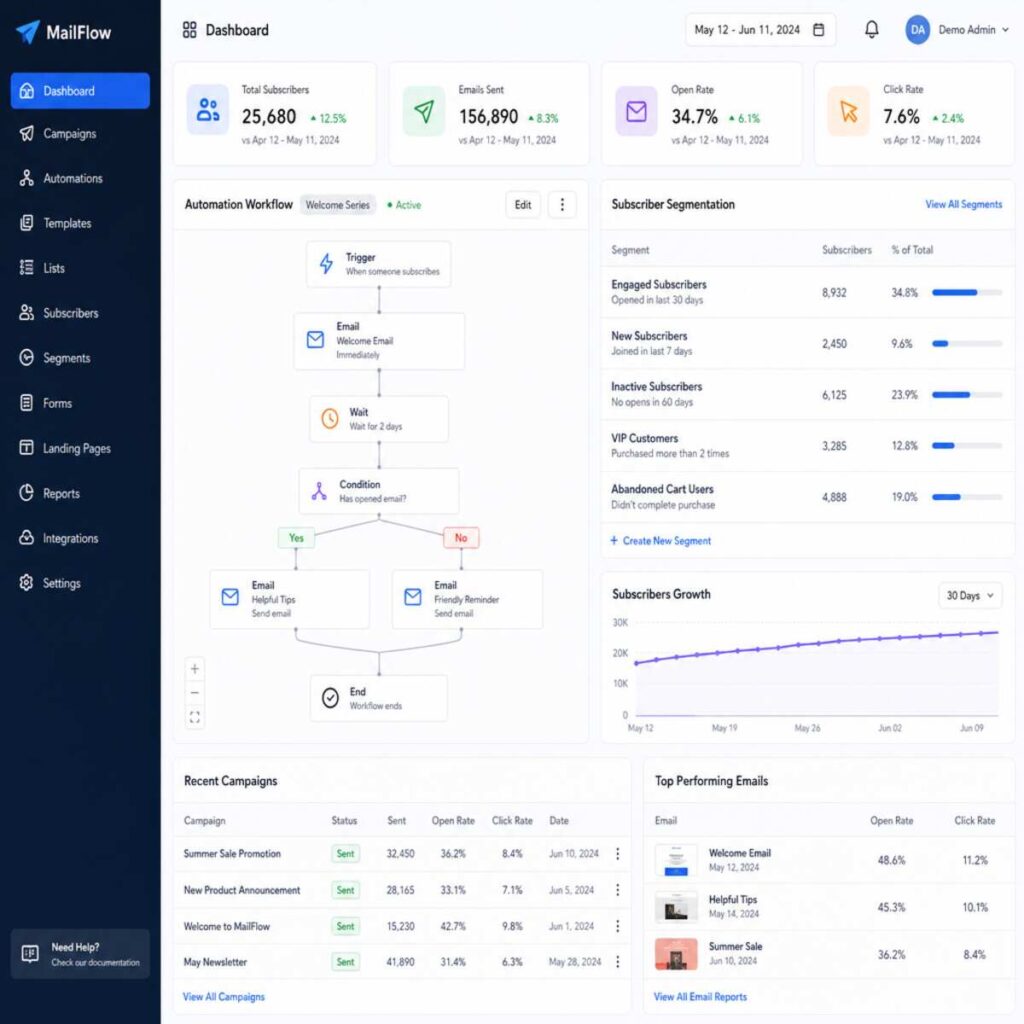
Lead generation is useless without lead nurturing. Your platform should allow you to build complex, behavior-triggered workflows. For example, if a subscriber clicks a specific link in your welcome email, the system should automatically tag them and send them down a tailored funnel.
3. Deep Segmentation and Tagging
Batch-and-blast emails are a thing of the past. To maintain high engagement, you must send the right message to the right person at the right time. Segmenting subscribers for personalized lead nurturing based on their location, purchase history, or engagement level is a non-negotiable feature for modern marketers.
4. Robust Analytics and Testing
You cannot improve what you do not measure. Your chosen platform should offer granular analytics detailing open rates, click-through rates, and bounce rates. Furthermore, the ability to run experiments—like a/b testing subject lines for higher open rates—is essential for optimizing your campaigns over time.
The Best Newsletter Platforms for Generating Email Leads
Now that we know what to look for, let us explore the top contenders in the market. Each of these platforms has unique strengths, making them suitable for different types of businesses and creators.
1. ConvertKit: The Creator’s Powerhouse
ConvertKit was built from the ground up with digital creators—bloggers, YouTubers, podcasters, and course creators—in mind. It focuses heavily on text-based, highly deliverable emails rather than complex, image-heavy designs.
Key Lead Generation Features:
- Intuitive Landing Pages: ConvertKit offers a myriad of beautiful, highly customizable landing page templates that can be hosted on their domain or yours.
- Visual Automation Builder: Their automation interface is arguably the most user-friendly on the market, allowing you to create complex subscriber journeys with a few clicks.
- Incentive Emails: ConvertKit makes delivering a lead magnet incredibly easy. You can attach a PDF directly to the confirmation email, combining the opt-in and delivery process seamlessly.
Best For: Solo creators, authors, and coaches who want powerful automation without a steep learning curve.
2. Beehiiv: The Newsletter Growth Engine
Beehiiv has taken the newsletter world by storm, built by the early team behind the Morning Brew newsletter. It is designed specifically for writers who view their newsletter as the core product, rather than just a marketing channel.
When looking at the popular debate of beehiiv vs convertkit for digital creators, the distinction usually comes down to goals. ConvertKit is better for selling external products (courses, coaching), while Beehiiv is superior if the newsletter is the product.
Key Lead Generation Features:
- Native Referral System: Beehiiv includes built-in referral programs for organic subscriber growth. You can easily reward readers with stickers, exclusive content, or merchandise for referring friends.
- Recommendation Network: You can partner with other Beehiiv publications to cross-promote each other, generating highly qualified leads for free.
- Monetization Ready: It natively supports paid subscription models for digital newsletters, allowing you to seamlessly transition free leads into premium subscribers.
Best For: Publishers, journalists, and creators building media-style newsletters.
3. ActiveCampaign: The Automation Titan
If you are running a B2B business, a SaaS company, or a highly sophisticated e-commerce operation, ActiveCampaign is widely considered one of the best email services available. It is less of a simple newsletter tool and more of a comprehensive Customer Relationship Management (CRM) platform.
Key Lead Generation Features:
- Hyper-Personalization: ActiveCampaign’s dynamic content blocks allow you to change the text and images within an email based on the user’s tags.
- Site Tracking: It tracks what pages a lead visits on your website and triggers automated emails based on that behavior.
- Lead Scoring: You can automatically assign points to subscribers based on their actions (e.g., +5 points for opening an email, +10 for clicking a link), allowing your sales team to prioritize hot leads.
Best For: B2B companies, agencies, and advanced marketers who need CRM capabilities and complex behavioral automations.
4. MailerLite: The Budget-Friendly Overachiever
Bootstrapping a business is hard, and keeping software costs low is often a priority. If you are looking for affordable email marketing services for startups, MailerLite is the undisputed champion. Despite its low price point (including a generous free tier), it does not skimp on premium features.
Key Lead Generation Features:
- Clean Interface: MailerLite boasts one of the most modern, intuitive user interfaces in the industry.
- Interactive Features: You can embed surveys, quizzes, and product blocks directly into your newsletters to increase engagement.
- Pop-ups and Forms: It includes a highly capable form builder, allowing you to create timed pop-ups, exit-intent forms, and embedded sign-ups easily.
Best For: Startups, small businesses, and beginners looking for premium features on a tight budget.
5. HubSpot: The All-In-One Enterprise Solution
HubSpot is an inbound marketing behemoth. While its email marketing tool can be used standalone, its true power is unlocked when integrated with the broader HubSpot CRM and Marketing Hub.
Key Lead Generation Features:
- Unified Database: Every interaction a lead has with your brand (social media, website visits, support tickets) is tracked in one unified contact record.
- Advanced Lead Capture: Beyond standard forms, HubSpot offers conversational bots and live chat features to capture email leads directly from website interactions.
- Seamless Alignment: Perfect for aligning marketing lead generation efforts with the sales team’s outreach.
Best For: Scaling companies, mid-market enterprises, and B2B organizations with dedicated sales and marketing teams.
6. Substack: The Simplified Publishing Platform
Substack revolutionized the independent writing space by making it incredibly easy to start a newsletter and charge for it. While it lacks the complex automation of traditional email marketing platforms, it is unparalleled in its simplicity.
Key Lead Generation Features:
- Frictionless Setup: You can set up a Substack and start collecting emails in less than five minutes.
- Built-in Discovery: Substack’s internal network and recommendation engine help readers discover your publication, driving organic lead generation.
- Seamless Paywalls: It is the pioneer of paid subscription models for digital newsletters, allowing you to lock certain posts for paying members only.
Best For: Long-form writers, journalists, and thought leaders who want zero technical hassle.
7. Brevo (formerly Sendinblue): The Multichannel Master
Brevo stands out because it doesn’t just do email; it is a multichannel marketing platform. It allows you to combine email lead generation with SMS marketing and WhatsApp campaigns.
Key Lead Generation Features:
- SMS Integration: Capture phone numbers alongside emails and trigger automated SMS follow-ups.
- Transactional Emails: Brevo has incredibly reliable infrastructure for sending password resets, order confirmations, and other critical transactional messages.
- Flexible Pricing: Unlike most platforms that charge based on the size of your email list, Brevo charges based on the number of emails you send per month, which can be highly cost-effective for large lists that are emailed infrequently.
Best For: E-commerce stores and local businesses wanting to combine email and SMS marketing.
How to Grow an Email List from Scratch
Choosing among the Best Newsletter Platforms for Generating Email Leads is step one. Step two is actually getting people to give you their email addresses.
If you are wondering how to grow an email list from scratch, the answer lies in value exchange. People are highly protective of their inboxes today. They will not subscribe to your list just to “stay updated.” You must offer them something valuable, immediate, and highly relevant to their pain points. This is where the “Lead Magnet” comes into play.
High-Converting Lead Magnet Ideas
A lead magnet is a free incentive offered in exchange for an email address. Here are several high-converting lead magnet ideas you can implement today:
- The Actionable Checklist: People love quick wins. If you write a 2,000-word blog post on SEO, offer a condensed, one-page PDF checklist summarizing the steps. It is highly consumable and easy to create.
- Resource Libraries: Create a password-protected page on your website containing templates, swipe files, and exclusive videos. Users must enter their email to get the password.
- Email Courses: Instead of offering a massive eBook that no one will read, break the content down into a 5-day automated email course. This not only generates the lead but trains the subscriber to open your emails daily.
- Webinars and Masterclasses: Video content has a high perceived value. Hosting a free 45-minute training session is a fantastic way to generate highly qualified leads who are deeply interested in your topic.
- Quizzes and Assessments: “What type of entrepreneur are you?” or “Test your digital marketing knowledge.” Quizzes are highly shareable, and requiring an email address to see the results yields massive conversion rates.
- Templates and Swipe Files: Whether it is a Notion productivity template, a set of Canva social media graphics, or a folder of high-converting sales email scripts, giving people tools they can plug and play is irresistible.
Optimizing Your Website for Lead Capture
Once you have your lead magnet, you need to place it where people can see it.
If you are using a popular CMS, integrating sign-up forms on WordPress is generally a straightforward process. Most of the platforms mentioned above offer native WordPress plugins. Simply install the plugin, connect your API key, and you can start embedding forms directly into your posts using shortcodes or block editors.
Best Practices for Form Placement:
- The Hero Section: The top of your homepage (above the fold) should feature a clear value proposition and an opt-in form.
- Exit-Intent Pop-Ups: Use a script that detects when a user’s mouse moves toward the “close” button on their browser, triggering a final offer to join your list.
- In-Line Content: Embed forms directly in the middle of your high-traffic blog posts, contextually relevant to what the user is currently reading.
- The Footer: While it has a lower conversion rate, having a static form in your website footer ensures there is always a way to subscribe, no matter what page the user is on.
Maximizing Lead Quality: The Opt-In Debate
When setting up your lead generation forms, you will be faced with a critical technical decision that impacts both list size and list quality. You must understand the nuances of double opt-in vs single opt-in lead quality.
Single Opt-In
With a single opt-in, the moment a user types their email and hits “submit,” they are added to your list and receive your lead magnet immediately.
- Pros: It provides a frictionless user experience, resulting in a faster list growth rate (usually 20-30% higher).
- Cons: You will inevitably collect fake emails, misspelled addresses, and bot submissions, which can harm your sender reputation over time.
Double Opt-In
With a double opt-in, after the user submits the form, they receive a confirmation email. They must click a link inside that email to officially join the list and receive the lead magnet.
- Pros: It guarantees that the email address is valid and that the owner truly wants your content. This leads to significantly higher open rates, lower bounce rates, and a pristine sender reputation.
- Cons: You will lose a percentage of leads who forget to check their inbox or whose confirmation email lands in the spam folder.
The Verdict: If you are a new creator prioritizing rapid growth, a single opt-in (paired with a good email verification tool) might be best. If you are a B2B company prioritizing lead quality and sales readiness, double opt-in is the gold standard.
The Science of Deliverability: Reaching the Inbox
You can use the best newsletter platforms, write the most compelling copy, and offer the greatest lead magnets in the world, but it all means nothing if your emails land in the spam folder.
A frequent question in marketing communities is: which newsletter tool has highest deliverability? The truth is, while platforms like ActiveCampaign, ConvertKit, and MailerLite invest heavily in maintaining world-class server reputations (often boasting 98%+ deliverability rates), your deliverability is largely dependent on your actions as a sender.
Technical Foundations for Deliverability
To ensure your emails reach the primary inbox, you must authenticate your sending domain. This proves to internet service providers (ISPs like Gmail and Yahoo) that you are who you say you are.
- DKIM (DomainKeys Identified Mail): Adds a cryptographic signature to your emails.
- SPF (Sender Policy Framework): Tells ISPs which IP addresses are authorized to send emails on behalf of your domain.
- DMARC (Domain-based Message Authentication, Reporting, and Conformance): Tells ISPs what to do if an email fails DKIM or SPF checks.
As of early 2024, Google and Yahoo have made these authentication protocols mandatory for bulk senders. Choose a newsletter platform that makes setting up these DNS records simple and provides clear documentation.
List Hygiene and Engagement
ISPs monitor how your audience interacts with your emails. If your subscribers constantly open your emails, reply to them, and move them out of the promotions tab, ISPs will deliver your future emails to the primary inbox. If your subscribers ignore you or mark you as spam, you will be penalized.
To maintain high deliverability:
- Scrub Your List: Every 3 to 6 months, remove “cold” subscribers who have not opened an email in the last 90 days. Segmenting subscribers for personalized lead nurturing helps identify who is active and who isn’t.
- Ask for the Reply: In your welcome email, ask a simple question and encourage the user to hit “reply.” A reply is the strongest positive signal you can send to an ISP.
- Avoid Spam Trigger Words: Keep your subject lines natural. Avoid using all caps, excessive exclamation marks, or words like “FREE,” “GUARANTEE,” or “CASH” unnecessarily.
Navigating Legalities: Privacy and Data Protection
In today’s digital landscape, generating email leads requires strict adherence to global privacy laws. Failing to comply can result in massive fines and severe damage to your brand’s reputation.
Compliance with GDPR for Email Marketers
If you have subscribers located in the European Union, you must adhere to the General Data Protection Regulation (GDPR). Even if you are based in the US or elsewhere, it is best practice to operate a GDPR-compliant list.
Key Requirements for Email Marketers:
- Explicit Consent: You cannot use pre-ticked boxes. The user must actively check a box stating they agree to receive promotional emails from you.
- Clear Data Usage: Your opt-in form must clearly state what the user is signing up for and link directly to your privacy policy.
- Granular Opt-Ins: If you are offering a free eBook but also want to add them to your weekly newsletter, you theoretically need separate consent for both actions under strict GDPR interpretations.
- The Right to be Forgotten: You must provide an easy, one-click unsubscribe link in every single email. Furthermore, if a user requests that you delete all their data, your platform must allow you to wipe their record completely.
When selecting your software, ensure it has native GDPR compliance tools. Platforms like MailerLite and ActiveCampaign have built-in toggles that automatically add compliant checkboxes and privacy text to your forms for EU visitors.
Crafting the Perfect Newsletter Experience
Once you have successfully captured the lead, the focus shifts to engagement. How do you keep them reading week after week?
The Importance of Mobile Optimization
Over 60% of all emails are now opened on mobile devices. If your newsletter looks beautiful on a 27-inch desktop monitor but is unreadable on an iPhone, you will lose subscribers rapidly.
Mobile optimization for newsletter content is non-negotiable.
- Use Single-Column Layouts: Multi-column designs often break or stack awkwardly on small screens. Stick to a clean, single-column flow.
- Enlarge Fonts: Use a minimum of 16px font size for body text to ensure readability without zooming.
- Optimize Images: Compress your images so they load quickly on cellular data, and ensure your platform uses responsive image tags so they resize automatically.
- Tap-Friendly Buttons: Make your Call to Action (CTA) buttons large and surrounded by plenty of whitespace so they are easy to tap with a thumb.
Mastering the Subject Line
Your subject line is the most critical component of your email. It is the gatekeeper. If it fails, all the work you put into the newsletter content is wasted.
The best marketers rely on data, not guesswork. This is why a/b testing subject lines for higher open rates is a daily practice. Most top-tier newsletter platforms allow you to write two different subject lines. The software will send Option A to 10% of your list and Option B to another 10%. After a set period (e.g., two hours), it determines the winner based on open rates and automatically sends the winning subject line to the remaining 80% of your list.
Variables to A/B Test:
- Length: Short and punchy vs. long and descriptive.
- Curiosity vs. Clarity: (e.g., “The secret to SEO…” vs. “5 steps to improve your SEO”).
- Personalization: Using the subscriber’s first name vs. no name.
- Emojis: Test whether emojis increase visibility or look unprofessional to your specific audience.
Turning Subscribers into Advocates
As your list grows, your focus should shift from solely acquiring cold leads to turning your existing audience into a growth engine.
Implementing referral programs for organic subscriber growth is one of the most cost-effective ways to scale. As mentioned earlier, platforms like Beehiiv have revolutionized this space by baking it directly into the software. However, you can use third-party tools like SparkLoop to integrate referral programs into platforms like ConvertKit or ActiveCampaign.
How to Execute a Successful Referral Program:
- Set Attainable Milestones: Don’t ask a subscriber to refer 10 people for their first reward. Make the first milestone incredibly easy (e.g., “Refer 1 friend to get our exclusive PDF guide”).
- Offer High-Value Incentives: Merchandise (mugs, stickers, t-shirts) works incredibly well, but digital rewards (access to a premium community, a 1-on-1 consultation, or a discount code) are cheaper to scale.
- Keep it Top of Mind: Embed the subscriber’s unique referral link at the bottom of every single newsletter, along with a visual tracker showing how close they are to their next reward.
Conclusion
Building an email list is the most high-leverage marketing activity you can engage in today. By choosing among the Best Newsletter Platforms for Generating Email Leads, you are laying a foundation for sustainable, algorithm-proof business growth.
Remember that the “best” tool is highly subjective. If you are a solo creator looking to monetize your writing, the beehiiv vs convertkit for digital creators debate is where you should focus your research. If you are a startup needing robust features on a dime, explore affordable email marketing services for startups like MailerLite. If you are running a B2B empire, invest in the CRM power of ActiveCampaign or HubSpot.
Success in email marketing requires a holistic approach. You must create high-converting lead magnet ideas, respect user privacy through compliance with gdpr for email marketers, protect your sender reputation to ensure your chosen newsletter tool has highest deliverability, and continuously optimize your engagement through mobile optimization for newsletter content and a/b testing subject lines for higher open rates.
Start by mapping out your business goals, evaluate the newsletter automation software features that align with those goals, and choose your platform confidently. Your future audience is waiting.